

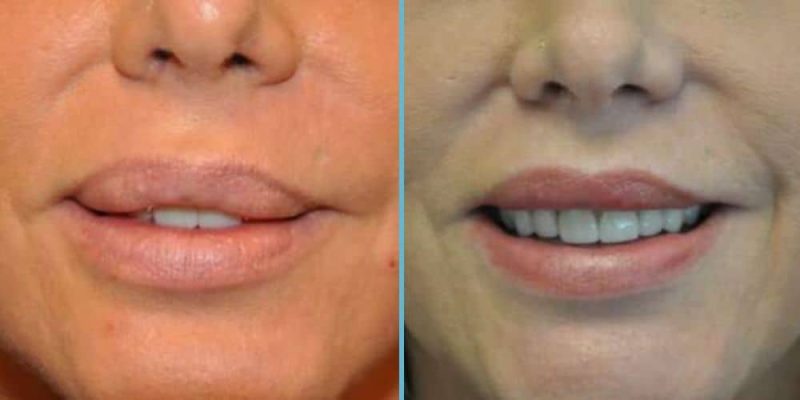
Silicone Lip Reduction
Permanent silicone injections were once promoted as a way to create fuller lips without the need for repeated filler treatments.
The problem is contained in the word permanent.
The silicone does not simply disappear as the face ages. The lips, however, continue to change.
Years after silicone injections, some patients develop lips that appear excessively large, irregular, lumpy, asymmetric, droopy, or unnaturally projected. In some cases, patients who were initially very happy with their lip augmentation begin noticing significant changes many years later.
Silicone lip reduction is a surgical procedure designed to improve these problems by reducing excess lip tissue and correcting as much of the associated deformity as reasonably possible.
Why Can Silicone-Injected Lips Change Over Time?
The lips are among the most mobile structures of the face.
Every day they move thousands of times while we speak, smile, eat, drink, and make facial expressions. At the same time, normal aging causes changes in collagen, skin elasticity, soft tissue, and the underlying structures of the lips.
Silicone is different from temporary fillers because the body cannot simply metabolize it and make it disappear.
Over time, silicone can become incorporated into the tissues of the lip. Scar tissue and inflammatory tissue can develop around it, and irregularities can become increasingly apparent as the surrounding lip continues to age.
The result can be:
- Excessively large lips
- Multiple lumps or bulges
- Asymmetry
- An unnatural pout
- Drooping or hanging lip tissue
- Irregularities that become more obvious when smiling
- A firm or unnatural texture
Patients sometimes describe feeling that their lips no longer look like their own.
Can All of the Silicone Be Removed?
Usually, no.
This is extremely important for patients to understand.
Injected silicone does not necessarily remain as one isolated collection that can simply be removed. Over time, microscopic silicone particles can become incorporated into the muscles, minor salivary glands, scar tissue, and other tissues of the lip.
Attempting to remove every particle could cause significant damage to the lip.
For that reason, the objective of silicone lip reduction is generally not complete silicone removal.
The goal is to reduce excessive or distorted tissue, improve contour and symmetry, and create a lip that looks more proportionate and natural.
How Is Silicone Lip Reduction Performed?
Every silicone lip is different, so the operation must be customized.
I begin by examining the lips at rest and during facial animation. Smiling is particularly important because silicone-related deformities and asymmetries may become much more apparent when the muscles of the lip contract.
The areas requiring reduction are then carefully marked.
In many patients, excess tissue can be removed through an incision placed along the inner portion of the lip. I generally perform a horizontal elliptical excision of mucosa while keeping the incision at or behind the wet line—the transition between the externally visible dry lip and the moist inner lip.
This allows the surgical scar to remain largely concealed inside the mouth.
The amount and location of tissue removed must be carefully planned. Removing too little may leave significant deformity, while overly aggressive removal can create additional problems.
The objective is not simply to make the lip smaller. It is to reshape the lip.
Upper Lip, Lower Lip, or Both?
Some patients require treatment of only the upper lip or only the lower lip.
Others have silicone-related changes involving both.
When both lips require significant surgery, I determine whether they should be treated together or whether a staged approach would provide better control over shape and healing.
Patients who have undergone previous attempts at silicone removal or lip reduction can be considerably more complicated because normal anatomy may already have been altered by previous surgery and scar tissue.
What Is Recovery Like?
Significant swelling should be expected after lip surgery.
Because the lips are constantly moving, patients must be careful during the early healing period. A soft diet is generally recommended initially to minimize trauma to the incision.
Sutures and healing are evaluated during follow-up, and normal lip activity is gradually resumed.
It is important not to judge the final result immediately after surgery. Swelling, firmness, asymmetry, and changes in sensation can occur during the healing process and gradually improve.
What Are the Limitations of Silicone Lip Reduction?
Silicone lip reduction can produce substantial improvement in properly selected patients, but it cannot restore a silicone-injected lip to exactly the condition it was in before the injections.
Some silicone remains within the tissues.
The original softness and texture of an untreated lip may not be completely recoverable. Residual irregularity or asymmetry may remain, and occasionally revision surgery may be appropriate.
There are also surgical risks, including bleeding, infection, scarring, asymmetry, contour irregularity, and temporary or permanent changes in lip sensation.
A patient considering this procedure needs realistic expectations.
Dr. Janjua’s Approach to Silicone Lip Reduction
I have treated patients with silicone-related lip deformities for many years, including patients who have traveled to my New Jersey practice from across the United States and internationally.
One of the most important lessons from treating these patients is that silicone lip reduction is not simply a matter of removing silicone.
It is reconstructive reshaping.
The surgeon must evaluate where the abnormal tissue is located, how the lip moves, how much tissue can safely be removed, and what contour will remain after healing.
My philosophy is therefore conservative: remove enough tissue to create meaningful improvement while preserving the function and natural anatomy of the lip.
The objective is a lip that is smaller, smoother, better balanced, and more natural appearing—not an attempt to remove every microscopic particle of silicone.
Considering Silicone Lip Reduction?
Patients frequently discover my practice after searching for solutions to silicone-injected lips, particularly when they have been told that nothing can be done.
Although silicone cannot usually be completely removed, surgical reduction may significantly improve the size, contour, and appearance of the lips in appropriately selected patients.
Janjua Facial Surgery is located in Bedminster, New Jersey and treats patients locally as well as patients traveling from across the United States and internationally.
For patients traveling from outside New Jersey, photographs and a virtual consultation can be used as the first step in determining whether an in-person evaluation is appropriate.
To discuss silicone lip reduction, contact Janjua Facial Surgery at (908) 470-2600 to schedule a consultation with Dr. Tanveer Janjua. Learn more at janjuafacialsurgery.com.
Silicone-related lip deformity varies considerably between patients. Complete silicone removal is generally not possible, and results cannot be guaranteed. An individual surgical evaluation is necessary to determine treatment options.